A Legacy Chalet with a Minimalist Architectural Approach
Scandinavian design outside and thoughtfully curated traditional interiors prove a winning combination.

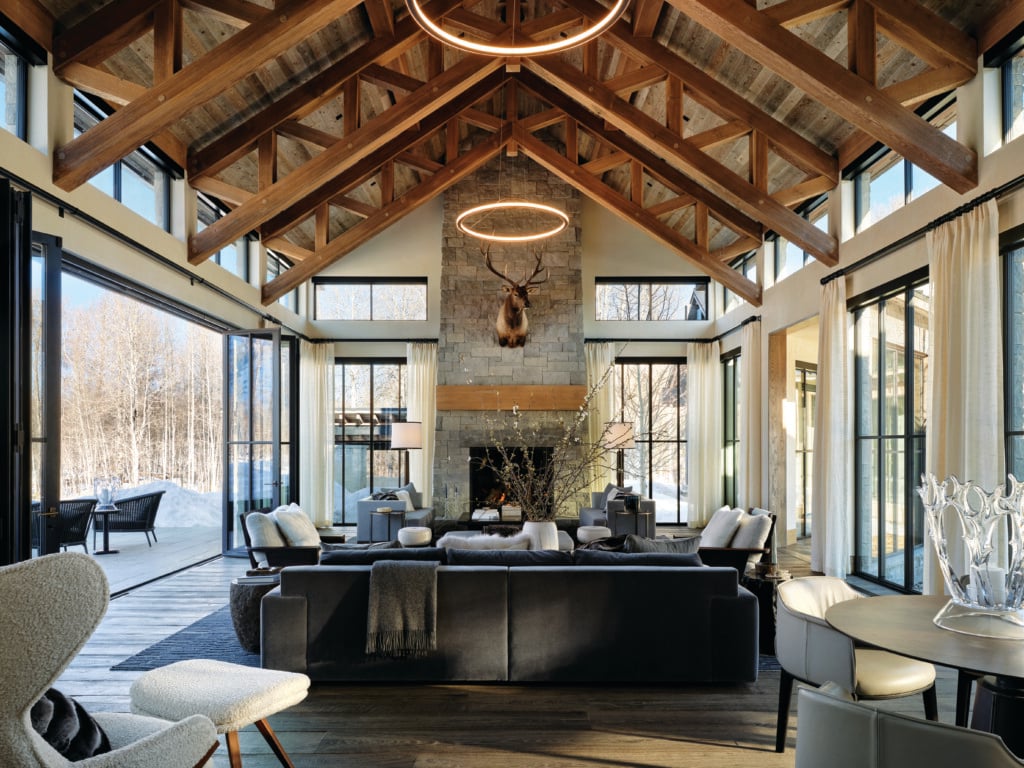
Drawing inspiration from the natural surroundings, in the great room, the designers introduced a sofa touting a deep purple Loro Piana fabric to match the mountains and sky-colored tufted George Smith chairs. | Photo: Mellon Studio
For Jill and Adam Pierce, a move to the mountains was inevitable: Jill grew up skiing in Deer Valley, Utah, and Adam is a Colorado native. So when the Arizona-based couple began imagining a legacy retreat for their three teenage sons and generations to come, Victory Ranch checked all the boxes.
Located near Park City, amenities including a golf course, fly-fishing on the Provo River, and extensive hiking and biking trails were part of the initial attraction. In fact, it was the freestone stretch of the river meandering past the golf course that sealed the deal: “Adam is an avid fly-fisherman,” says Jill. “Our golf cart carries fly rods.”

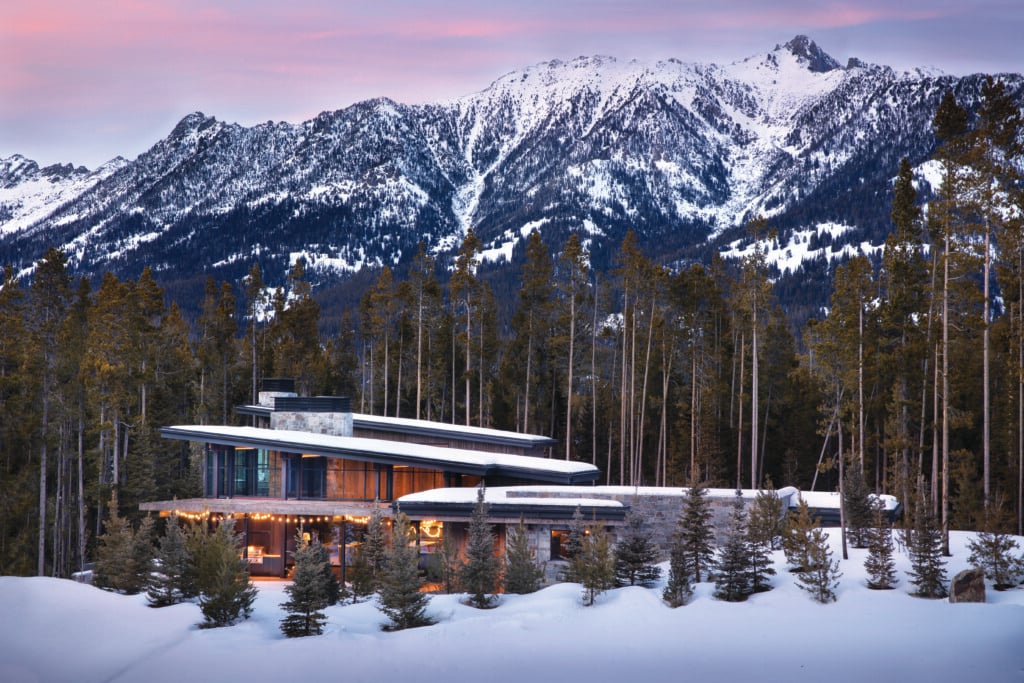
Simple stone and wood structures are topped with unembellished gable rooftops. | Photo: Mellon Studio.
From the outset, the Pierces had a clear vision. “I was very inspired by the Rothschild family ski chalet in the French Alps,” says Jill, referencing the iconic architectural style pioneered by Henry-Jacques Le Même in the 1920s. Its stone-and-wood farmhouse vernacular resonated with the couple, who imagined something similarly rugged yet refined, and timeless.
That sensibility became the guiding principle for Moonrise Lodge, which features a central living structure wrapped in weathered cedar with two stone-clad companions including a detached garage designed by architect James R. Meyer of JRM/A: The Studio For Architecture. “The owners like Scandinavian design, so we emphasized simple forms and took a minimalist approach to the form and silhouettes of the structures,” says Meyer, pointing to the unadorned gable forms that define each of the buildings. Nestled within a five-acre parcel and sited in the saddle of a windswept ridgeline, the structures’ rooflines peek above the sagebrush of the woodland setting. “The home, when viewed from above, looks like the quintessential house on the prairie,” he says.

“The house has such clean architectural lines; the cabinetry serves to complement those elements,” says interior designer Andrika King about the Henrybuilt kitchen system. The counters and backsplash are Capolavoro quartzite, and the counter stools are by BassamFellows. | Photo: Mellon Studio
Inside, wood and stone are again the dominant materials. Custom-milled white oak planks line the walls, stacked stone fireplaces echo the exterior masonry, and rough-hewn stone floors
with radiant heat ground the interiors. Meyer worked closely with Matt Schroeder of The Cosine to design the discreet uplighting that warms the steeply pitched ceilings, while contractor Build Utah orchestrated extensive custom millwork and the installation of imported masonry.
The design aesthetic shifts to a traditional, collected feel with European accents. In the great room, an 18th-century Italian chandelier introduces a note of Old World glamour above elegant seating designed for relaxing after a day outdoors. Oversize sheepskin lounge chairs by Finnish architect Märta Blomstedt mingle with tufted blue armchairs from George Smith and a custom purple sofa—hues pulled from the surrounding hillsides visible through walls of glass.

A sectional wearing plaid Holland & Sherry fabric signals the casual nature of the lower-level family/media room. The coffee table is vintage, and the stools were found at the Round Top Antiques Show. | Photo: Mellon Studio
“There’s so much purple in the hillside; it should appear in more mountain homes,” says interior designer Jen Hart of Park City-based Jen Hart Interiors, who collaborated with Andrika King of Andrika King Design on the seamless mix of furnishings and colors. “We also used blues, greens and browns as complements to the Provo River Valley.”
Noting that the Pierces wanted the central gathering place to have a cozy, lodge-like feel, the designers created distinct moments within the expansive space. A vintage Swedish game table paired with Italian Giorgetti chairs anchors one side; opposite, a cozy bar area layers a 1920s sofa in its original leather with the clean lines of upholstered counter stools. The blend of old and new repeats throughout the house.

Located near the lower-level family/media room, this bar features counter stools upholstered in Jerry Pair suede, and mini antler chandeliers—a fun Western nod, from Antler Worx. | Photo: Mellon Studio
Downstairs, in the family room, for example, an oversize sectional sporting blue plaid meets leather chairs with Midcentury Modern profiles. “Plaid is a traditional pattern for the countryside, but we went with the blue to have a bit of fun and give the boys a casual, indestructible and fun place to hang out,” says King.
Ultimately, the Pierces sought a departure from predictable Mountain Modern style. “The idea was to create something truly bespoke,” Hart says. The result is a family-friendly chalet that marries alpine romance with contemporary ease.

Custom-milled white oak planks define the upper-level bar area, where George Smith counter stools wear Fleurons d’Helene fabric. The counters are Jadore quartzite. | Photo: Mellon Studio
Rock Solid
Stone is a defining element in mountain design. Structurally strong and inherently timeless, it melds beautifully with rugged surroundings and instantly conveys a sense of permanence. For this Utah home, architect James R. Meyer embraced stone not only for its durability, but to make a deliberate architectural statement. Here, he shares a couple of lessons learned from working with one of the most elemental building materials.
Color Is Key: Selecting the proper hue ensures that the home settles naturally into its surroundings rather than competing with them. “We looked at dozens of stones before finding one that felt right in the landscape—with just a hint of gold to complement the cedar siding,” Meyer says.
The Lay-Up: Stone can be cut and stacked evenly for a refined finish or left in a more natural state to evoke age. Seeking the latter, Meyer notes that the irregular shapes and proper installation were essential. “I wanted it to feel as though, at some point, someone gathered stone from the property and built a structure by hand.”

Overflow sleeping quarters include a space where three beds have Rogers & Goffigon fabric headboards. Verellen chairs surround a game table by Santa & Cole. | Photo: Mellon Studio

More sleep options are found in the bunk room, where the clam chairs are by Philip Arctander. | Photo: Mellon Studio

The same stone, wood and plaster seen elsewhere in the house repeats in the primary bedroom. A vintage French chaise from Galerie Half establishes a relaxed tone, and a rug from Amadi Carpets warms the stone floor. | Photo: Mellon Studio
DESIGN DETAILS
ARCHITECT – JRM/A: The Studio for Architecture
INTERIOR DESIGN – Jen Hart Interiors and Andrika King Design
CONSTRUCTION – Build Utah